

XR Therapy & Immersive Wellness
Author
Elisha Roodt
Date Published
Rewiring Care Pathways Through Spatial Computing
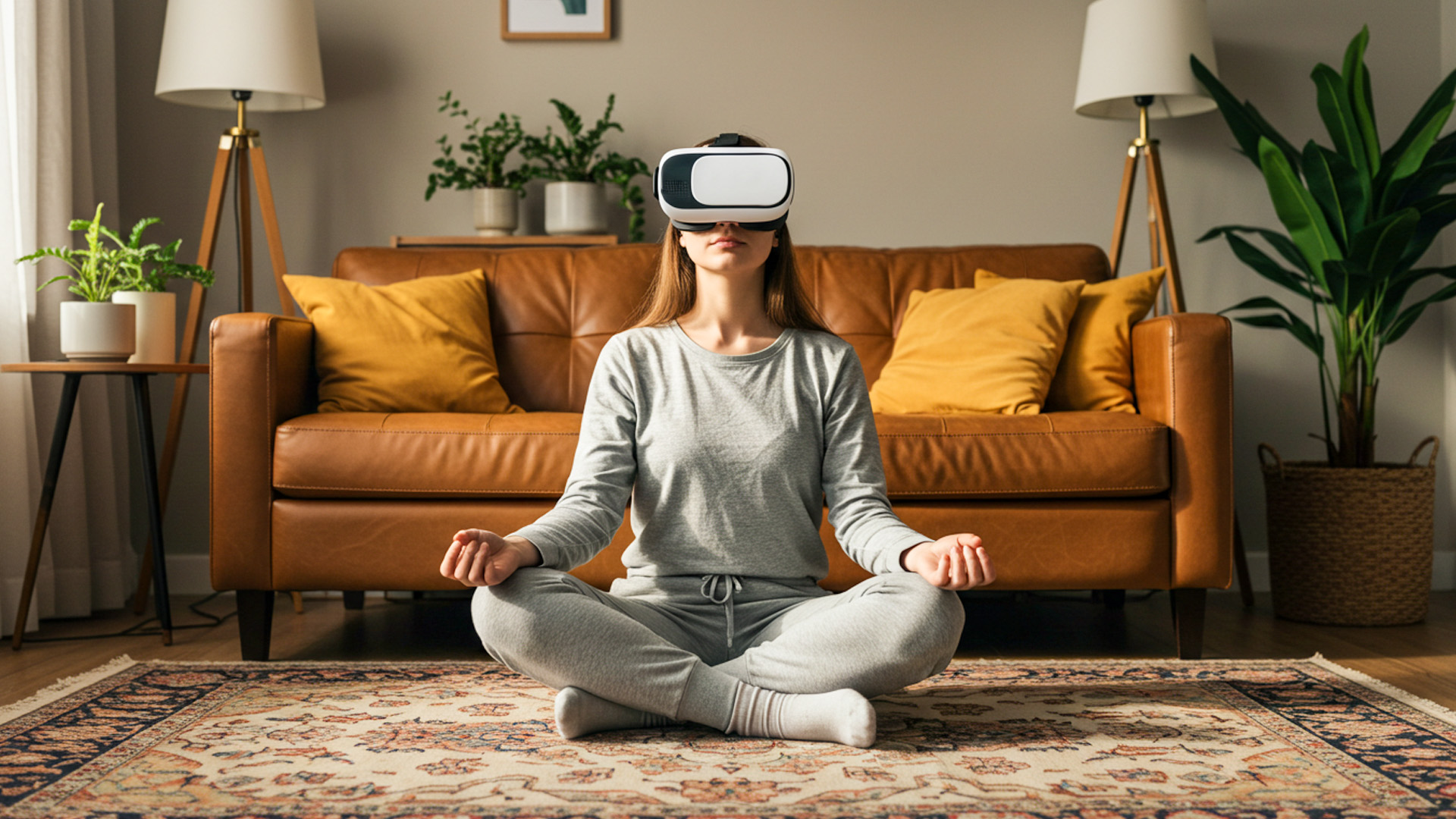
Across clinics, living rooms, and training labs, extended reality (XR) is refactoring how we prevent, diagnose, and treat. Head-mounted displays, passthrough AR, hand tracking, and haptics now converge into embodied interfaces that feel less like “apps” and more like habitats. Patients step into graded-exposure scenes instead of scrolling menus. Fitness seekers meet adaptive coaches that read physiology, not just taps. Physiotherapists prescribe virtual task practice with millimeter-level motion capture and real-time cues. Educators run high-fidelity simulations that adapt to errors, tempo, and stress biomarkers. This piece explores how VR therapy, AR/VR fitness, rehabilitation, and remote healthcare training cohere into a practical, evidence-attuned playbook. Along the way, we’ll use scenario vignettes and metaphors—like “digital physiologies” and “kinetic UX”—to render complex mechanics graspable.
VR Therapy for Mental Health Support
Graded Exposure as a Spatial Ladder
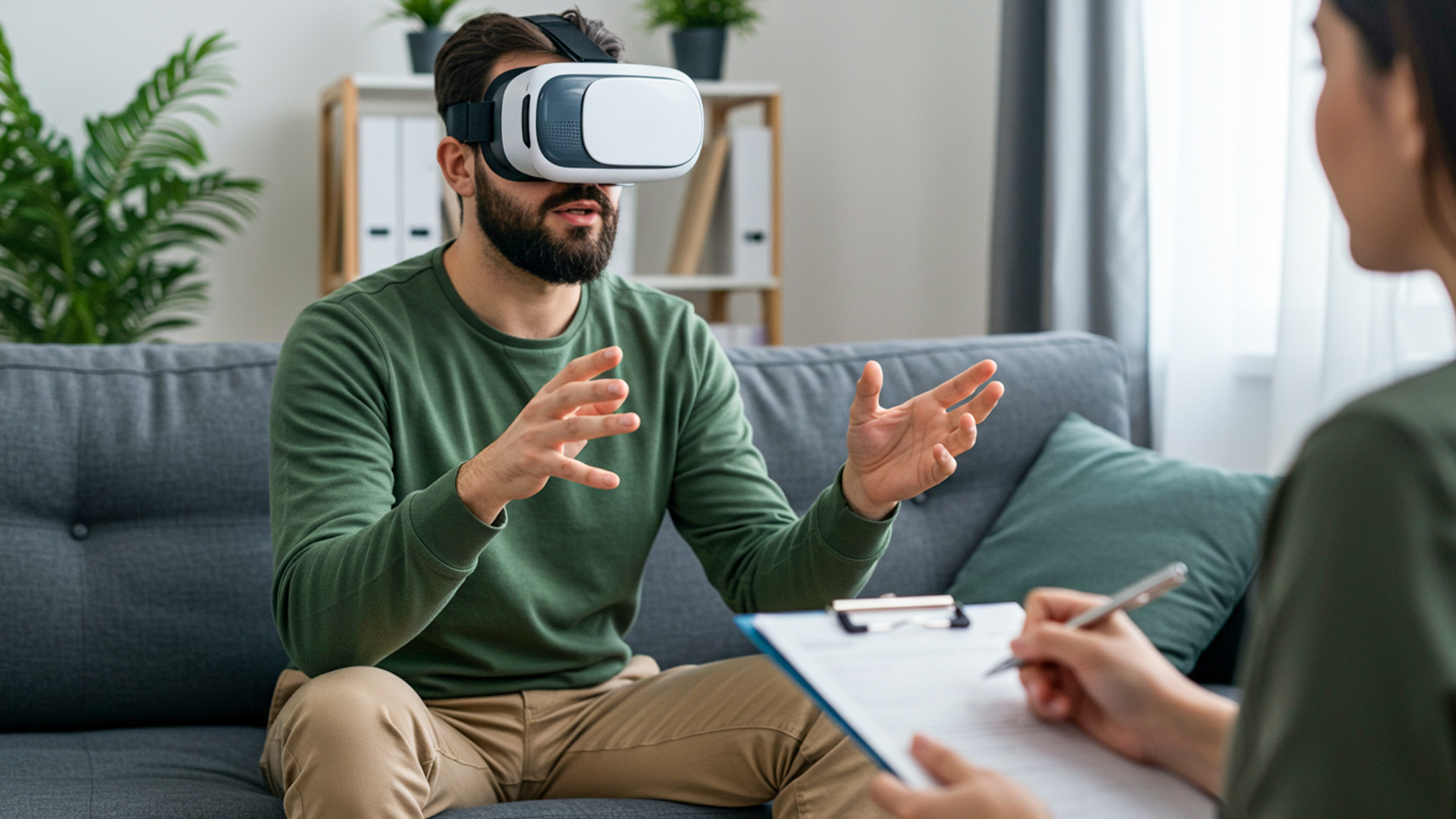
Picture Sam, who avoids crowded trains due to panic triggers. Traditional exposure asks Sam to imagine a carriage; VR lets Sam inhabit it. We can parametrize density, noise, lighting, and proximity, surfacing just-manageable discomfort while maintaining a perceived locus of control. A therapist co-pilots from a dashboard, dialing arousal up or down through micro-scenarios—doors jam, announcements echo, or the crowd thins. This spatial ladder transforms abstract homework into embodied rehearsal, reducing catastrophic prediction errors. A session becomes a closed-loop system: stimuli raise anxiety, coached breathing dampens it, and repeat exposures reconsolidate memory with less fear tagging, progressively shrinking avoidance maps.
Technically, the scene graph doubles as a clinical protocol. Parameters—field of view shifts, crowd agent counts, acoustic reverb—map to titration knobs. Biometric inputs (heart rate variability, respiratory rate) provide a live readout of sympathetic load, enabling adaptive pacing. The therapist’s console records exposures as structured events—timestamped intensity, chosen coping skill, and subjective units of distress—building a data exhaust for longitudinal analytics. Instead of brittle, one-size scripts, VR delivers procedural content where safety, agency, and plasticity are tunable. The result is a repeatable, measurable arc: anticipate, engage, downregulate, and reappraise, iterated until the brain treats the scenario as ordinary rather than existential.
Cognitive Tools Woven into the Environment
Exposures work best when cognitive frameworks are close at hand. In VR, psychoeducation is not a PDF; it’s an overlay that appears contextually. When negative automatic thoughts spike in a social scene, a “cognitive lens” can render thought bubbles, gently labeling catastrophizing or mind-reading with clinician-approved language. Anchors—like grounding objects or a re-centering portal—provide visual affordances for skills practice. Imagine a “breath kite” that rises and falls in sync with paced breathing; patients learn resonance frequency by literally flying their physiology. Because these tools are spatial and responsive, they become muscle memory, not just note-taking.
Implementation details matter. UI elements should respect vergence-accommodation comfort zones and avoid intrusive popups that break presence. Interaction grammars—gaze dwell, pinch, or voice—should fit motor profiles and cultural norms. Accessibility is not optional: subtitles for voice-guided relaxation, color-safe palettes, and configurable locomotion (teleport vs. smooth) reduce friction. Session state persists: which coping card was pinned, where the user practiced box breathing, and which distortions were flagged. Over time, the system learns to surface the right nudge at the right micro-moment, enacting a personalized cognitive scaffold that lowers cognitive load while preserving therapeutic challenge.
Safety, Ethics, and Telepresence
Therapeutic immersion must be bounded by psychological safety. Screening for dissociation risk, photosensitive seizure history, and motion sensitivity is table stakes. A visible “eject” affordance—single gesture or voice command—must immediately pause exposure, fade to neutral, and open live contact with the therapist. Remote sessions benefit from presence indicators: a “therapist shadow” avatar signals co-regulation without voyeurism. Logging is privacy-aware; PII is decoupled from biometric telemetry, and clinician notes are partitioned with strict role-based access controls. Transparency about data provenance and model behavior, especially if AI co-pilots triage or recommends stimuli, preserves trust.
Teletherapy raises new logistics. Network jitter can distort timing, which matters during exposure titration. Systems need resilient synchronization layers where critical events—panic spike markers, coping skill triggers—are guaranteed delivery. A fall-back to 2D video with screen-shared VR mirrors helps when headsets misbehave. For regulated environments, audit trails record who adjusted intensity, when consent was reaffirmed, and what safety plan was invoked. The ethic is clear: immersive does not mean opaque. Patients should understand what the system senses, what it infers, and how it adapts, with human oversight that remains visible and immediate across the session.
AR/VR Fitness Trainers and Immersive Wellness
From Reps to Rhythms: Biometrics as Game Mechanics
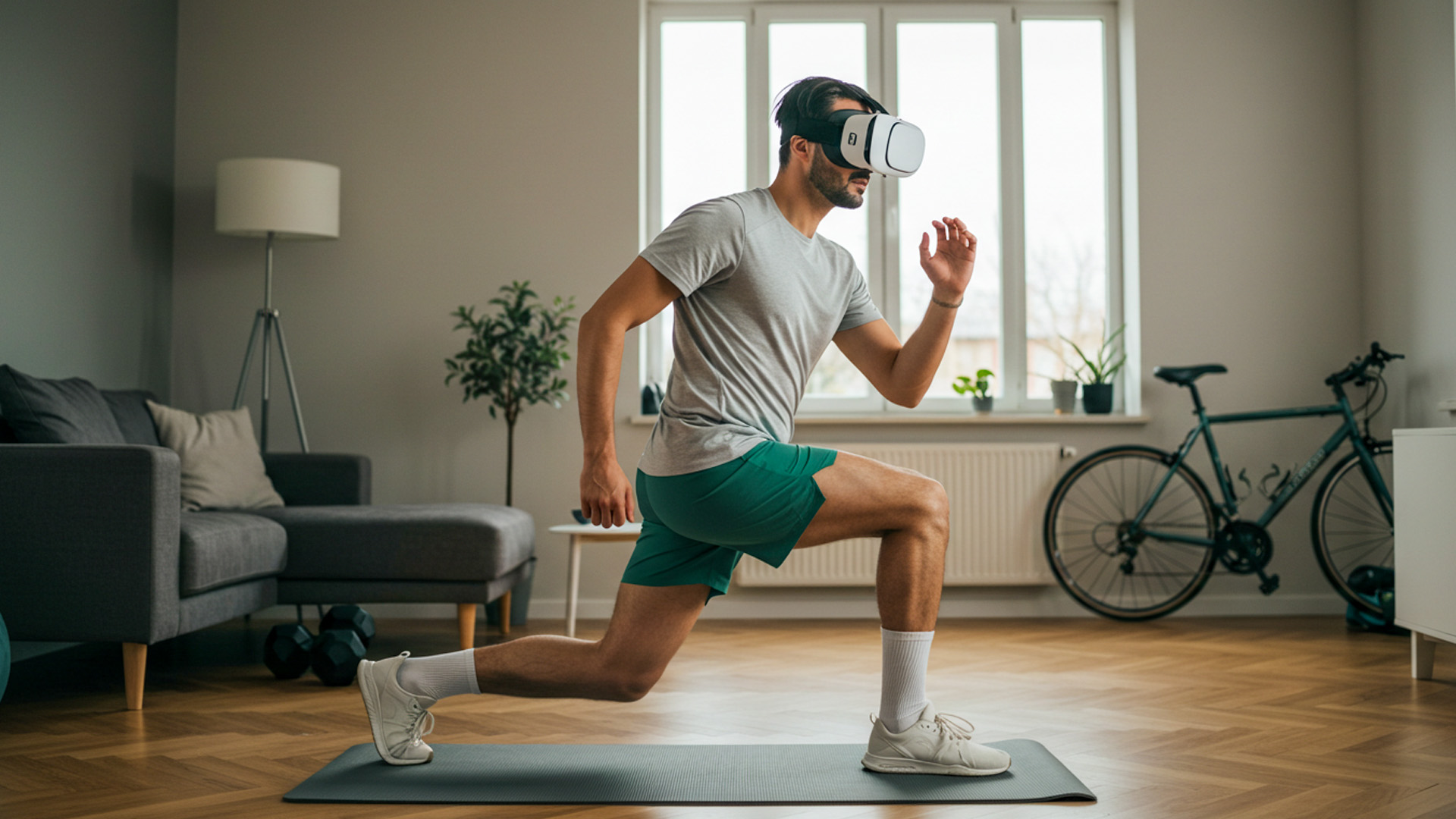
Wellness engagement often falters because feedback loops are slow and abstract. In XR, physiology drives the game. Imagine an at-home boxing session where your heart rate variability (HRV) becomes the stamina bar and lactate threshold informs pacing prompts. Beat-matched haptics nudge cadence; environmental resistance—wind, incline, or water viscosity—modulates with respiratory depth. The workout transforms into a bio-responsive score where recovery intervals open vistas and high-effort pushes spawn visual flourishes, tying effort to spectacle. Gamification avoids gimmickry when it metabolizes validated metrics into understandable, motivating mechanics.
Technically, this means low-latency sensor fusion. Wrist PPG alone struggles during motion; combining IMU-derived cadence with camera-based pose or head-mounted photoplethysmography improves robustness. A control loop adjusts target effort zones (e.g., 80–85% HRmax) based on real-time drift and perceived exertion inputs via quick voice prompts. Data smoothing uses short Savitzky-Golay windows to preserve on-beat responsiveness without whiplash. Export pipelines write to Apple Health, Google Fit, or EHR-adjacent stores with consent, while the 3D engine keeps motion-to-photon latency tight enough to avoid vestibular conflict. The net effect: workouts that feel coached by your own physiology.
Coaching Avatars with Real Pedagogy
Avatars only motivate if they teach well. A competent XR trainer models form with explainable feedback: “Shift ground reaction force by two centimeters laterally,” not “Do better.” In practice, that means multi-angle ghost overlays, contact-patch highlights, and temporal tracing that shows how a joint should travel through space. The coach’s patter is sequenced: prime (what), cue (how), and frame (why), mapping to motor learning phases. Users learn to chunk technique, e.g., “stack, engage, drive,” reinforced with time-stretched replays. The avatar isn’t just charismatic; it’s pedagogically literate, using constraints and affordances to elicit correct movement patterns.
To achieve this, the system runs a lightweight biomechanics pipeline. Pose estimation infers joint centers; inverse kinematics refines alignment relative to equipment or floor markers. Error detection then classifies deviations: excessive valgus collapse, lumbar overextension, or insufficient dorsiflexion. Each class maps to a coaching script and a visual overlay. A Bayesian learner tracks individual tendencies—say, hip shift on heavy squats—and front-loads cues accordingly. Compression happens on-device for privacy; only aggregate session summaries leave the headset. The outcome is a tutor that respects motor variability while steadily pulling movement toward safer, stronger attractors.
Social Mechanics Without Comparison Traps
Community fuels adherence, yet raw leaderboards invite unhealthy comparison. XR supports healthier social fabrics. Think cooperative boss fights where pooled recovery opens team buffs, or “relay intervals” where your active rest becomes someone else’s pace cue. Spatial audio and ambient presence—subtle silhouettes at the periphery—keep connection alive without overwhelming sensory channels. Post-session, highlights showcase technique improvements rather than vanity metrics. The goal is mutual attunement: we’re training together, not racing to exhaustion. Social objects—badges, routes, routines—are designed as conversation starters, not performance shaming devices.
Moderation and safety features underpin the vibe. Privacy toggles control how much physiology you share. A “consent to spot” mechanic lets a friend offer form check-ins while the system anonymizes raw camera feeds. Anti-harassment tools—mute, bubble, block—are accessible with one gesture. For minors or sensitive groups, curated sessions enforce positive norms and rest intervals. Seasonal events lean into play: aurora runs, gravity-bent yoga, or cooperative rhythm rides. The craft lies in choreography—pairing embodied challenge with psychological safety—so users accumulate micro-wins and keep showing up for the long arc of health.
Physiotherapy and Motor Rehabilitation in XR
Task-Oriented Rehab with Rich Feedback
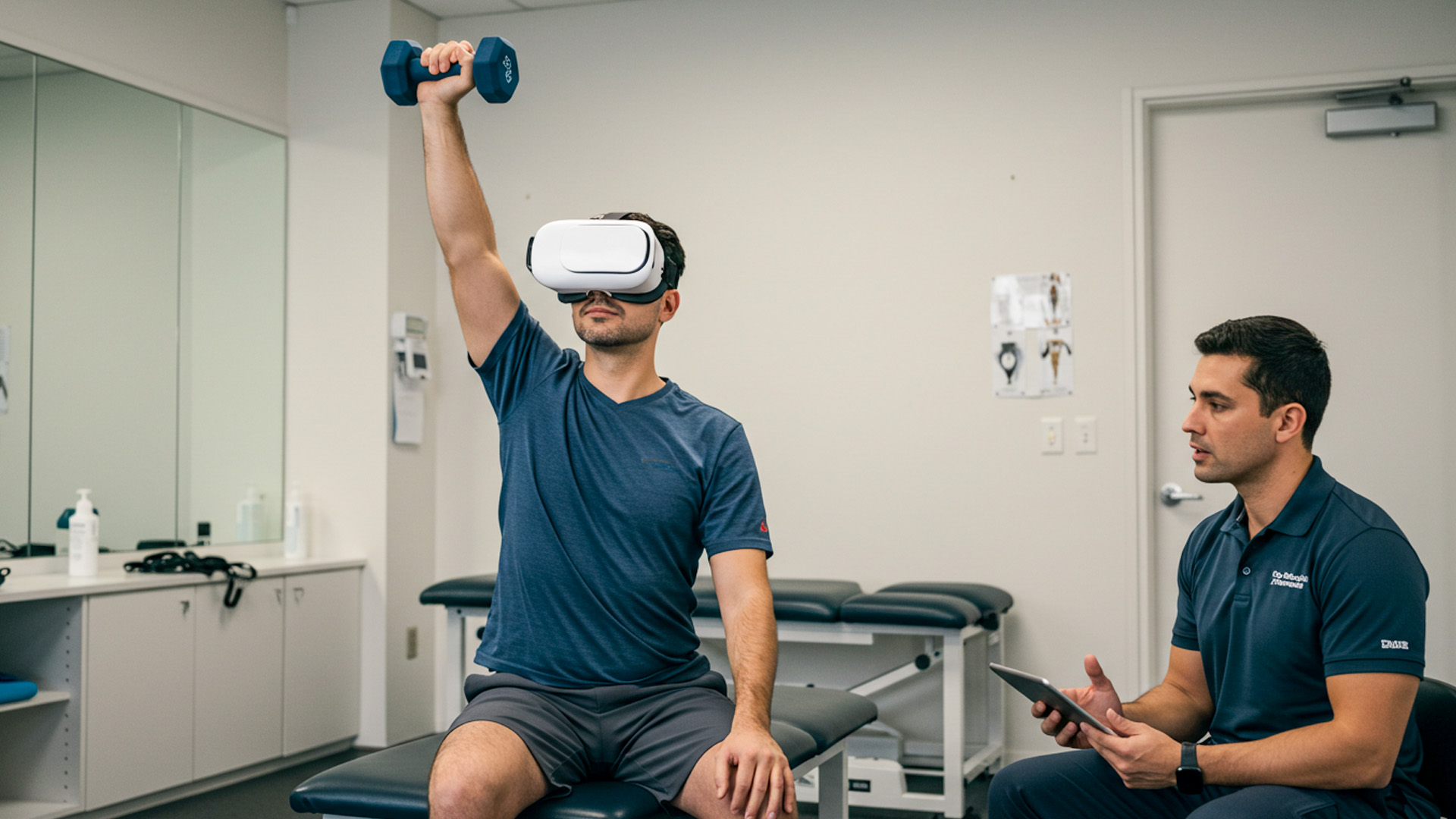
Consider Amina, post-stroke, regaining shoulder flexion. Instead of “lift to 90° ten times,” XR reframes the task: tend a virtual garden that requires reaching, grasping, and controlled lowering with graded object weights. Visual metaphors—glowing kinematic trails, velocity ribbons—render effort visible. Haptic nicks signal unsafe compensations like shoulder hiking. The therapist prescribes constraints (start positions, range windows, tempo targets) that the world enforces gently. Progress is not just repetitions; it’s smoother jerk profiles, reduced co-contraction, and functional carryover, evidenced when Amina pours a kettle in an AR overlay atop her real counter.
Under the hood, calibration establishes segment lengths and resting postures. Real-time pose pipelines fuse controller IMUs with optical markers or inside-out hand tracking to estimate joint angles. Feature extractors compute ROM, peak velocity, movement smoothness (e.g., SPARC), and path efficiency. These metrics stream to a therapist portal where goals align with International Classification of Functioning (ICF) codes. The system adapts difficulty via Laban-inspired effort qualities—press, glide, wring—modulating environmental viscosity or gravity as needed. Ultimately, therapy becomes a continuous control problem with explicit objective functions—range, quality, endurance—making progress quantifiable and motivating.
Adherence by Design: Rituals, Not Reminders
Home programs often fail, not from malice but from friction. XR reduces microlatency: one gesture loads today’s plan; a familiar space (the “rehab nook”) greets the patient; and a calming soundscape signals readiness. A ritualized warm-up—breath pacing with gentle reach—primes attention. Sessions conclude with a “debrief garden” where progress blooms as visible growth. Notifications are reframed as invitations from future-you, while streaks track consistency without punitive tones. The ritual feels like returning to a meaningful place rather than obeying a calendar ping. Patients build identity as active agents in recovery, not reluctant compliance machines.
Programmatically, adherence telemetry respects autonomy. Users can hide streaks during flare-ups; therapists can tag sessions as “paced” rather than “missed.” A lightweight recommendation engine suggests shorter “micro-sets” on high-fatigue days, preserving habit continuity. Content rotates to prevent boredom while preserving targeted patterns—e.g., three variations of scapular control tasks. Accessibility includes one-handed UIs, adjustable text, and seated/standing modes. For multilingual contexts, subtitles and localized metaphors improve resonance. The result is a resilient habit loop: enter, act, reflect, and return—supported by aesthetics that dignify, not infantilize, adult rehabilitation.
Clinical Data, Safety, and Integration
Rehab data are clinically meaningful only if standardized and interoperable. XR systems should export ROM in degrees with sensor provenance, encode outcomes against validated scales (e.g., Fugl-Meyer, DASH proxies), and separate raw from derived features. Error bars matter; confidence intervals accompany change scores so clinicians avoid over-interpreting noise. Safety checks enforce rest when tremor or pain signals spike, pausing scenarios and prompting symptom logs. Informed consent specifies what is shared with providers and what stays local. Edge compute keeps sensitive video on device, while aggregate metrics feed secure dashboards for longitudinal review.
Integration closes loops. HL7/FHIR adapters write session summaries into the record, enabling blended care with tele-visits. Flags—plateaus, regressions, adherence dips—trigger proactive outreach. Device management keeps headsets patched and hygienic with remote wipes and content updates. For payers, usage and outcome reports support value-based models without turning therapy into surveillance. Trials continue in background: A/B testing different cueing styles across anonymized cohorts to refine what works for whom. The ethos: rigorous, humane, and transparent—where data amplify clinical judgment rather than displace it.
Remote Healthcare Training and Clinical Simulation
Scenario Craft: Fidelity Where It Counts
Imagine a night-shift code scenario: dim lighting, alarm polyphony, and a family member asking questions at the bedside. High-fidelity XR simulation emphasizes functional realism—timing, task flow, and cognitive load—over photorealistic textures. Trainees manage airway steps while the environment reacts to decisions: oxygen saturation trends respond to mask seal quality; a virtual colleague mis-hears orders in noisy conditions unless you use closed-loop communication. The scene grids difficulty along dimensions—complexity, ambiguity, and tempo—so educators can “turn knobs” and observe behaviors under pressure, cultivating both technical and nontechnical skills.
Authoring tools matter. Modular scenario editors let educators specify states, triggers, and probabilistic branches without deep coding. Performance models define success envelopes—acceptable drug dose ranges, time-to-intervention bounds—while analytics label errors by category (omission, commission, communication). Debriefing is interactive: timelines overlay trainee actions with vital signs and team chat, enabling rich after-action reviews. Cloud sync supports distributed cohorts; edge caching preserves low-latency haptics and audio locally. The system becomes a rehearsal studio for clinical craft, where repetitions shape judgment, not just rote recall.
Assessment with Explainability
Rubrics often collapse nuanced performance into blunt scores. XR can preserve nuance while staying explainable. Instead of “competent = 3,” assessments expose component signals: recognition latency for deteriorating vitals, adherence to sepsis bundles, medication cross-checks, and teamwork markers like closed-loop confirmations. Each signal has thresholds and rationales visible to learners. When a rating dips, the system highlights the moment—a missed respiratory rate trend or ambiguous instruction—that drove the penalty. Learners see not only what fell short, but why, and how to repair the gap on the next run.
Technically, this involves event sourcing and causal attributions. The simulation emits a stream of structured events—intervention, parameter change, communication act—that feed a rules engine and, optionally, a supervised model trained on expert traces. Attribution graphs point from outcomes to antecedents with confidence levels, avoiding black-box vibes. Privacy gates ensure that analytics serve pedagogy, not punitive surveillance. For summative assessments, standardized scenarios and locked parameters maintain fairness, while formative runs flex for individualized coaching. The upshot: assessment that teaches, not just tallies.
Scaling Programs and Equity
Great simulations fail if they’re scarce. Programs scale by embracing device heterogeneity—stand-alone headsets, AR-capable phones, and desktop VR—with graceful degradation of features. Content delivery networks pre-stage assets, and licensing supports cohort-based access windows. For low-resource settings, offline modes cache scenarios and sync results later. Accessibility spans language, motor accommodations, and network realities. Partnerships with community colleges and rural hospitals shift XR from novelty to infrastructure, integrating with existing skills labs rather than replacing them. Equity isn’t a marketing slide; it’s a systems design constraint.
Operationally, this means fleet management, not one-off pilots. Admin consoles enroll users through SSO, push updates, and monitor device health. Content governance vets scenarios for bias and clinical validity. Faculty development includes coaching on debriefing in XR contexts—holding psychological safety while pushing rigor. Funding blends grants, subscriptions, and outcomes-based contracts, recognizing that retention and error reduction have real economic signatures. Through this lens, XR becomes a durable capability for healthcare systems—scalable, auditable, and tuned for the messy realities of human learning.